Green Papaya Salad Is Judging You: How to Actually Nail Som Tam at Home
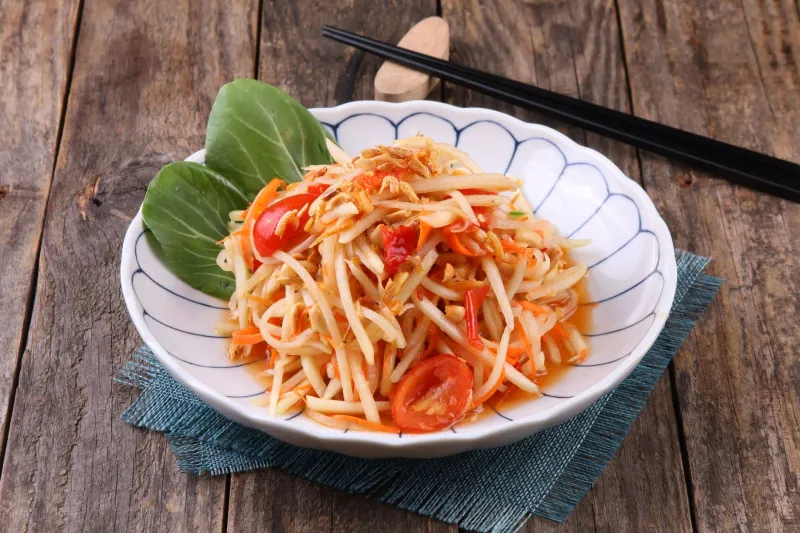
There's a street cart in almost every corner of Bangkok where a woman pounds out som tam with the kind of rhythmic confidence that makes it look effortless. She's not measuring anything. She's barely looking at what she's doing. And the salad she hands you in a plastic bag is electric — sharp, funky, spicy, a little sweet, and layered in a way that somehow keeps you reaching back in even when your eyes are watering.
Then you try to make it at home and it tastes like a sad lime salad with some peanuts on top.
Som tam has a reputation for being simple, and technically it is. The ingredient list isn't long. The process doesn't require any special cooking skills. But simple doesn't mean easy, and this dish has a way of exposing every shortcut you take. Let's talk about what's actually going wrong — and how to fix it.
The Papaya Situation
First things first: you need green papaya, not ripe papaya. This sounds obvious, but it's worth saying clearly because grocery store labeling in the US is inconsistent, and what one store calls "unripe" another might just call "green" while still selling you something that's starting to turn soft and sweet on the inside.
You want firm, pale, almost white flesh with no give when you press it. The flavor should be almost neutral — faintly vegetal, nothing sweet. If you can't find it at a regular grocery store, check your nearest Asian supermarket. H Mart, 99 Ranch, and most Vietnamese or Thai markets carry it reliably. If you're genuinely stuck, kohlrabi or chayote can work in a pinch, though the texture won't be quite the same.
Once you have the right papaya, how you cut it matters more than most recipes admit.
Shredding vs. Bruising: This Is the Part You're Skipping
A lot of American recipes for som tam tell you to shred the papaya on a box grater or run it through a mandoline. And sure, that gets the job done in terms of shape. But it's not the same thing as what's happening in that Bangkok street cart.
Traditional som tam technique uses a large knife and a mortar in tandem. You score the papaya with the knife in deep, close cuts, then use the pestle — or the spine of the knife — to knock those cuts loose into long, irregular strands. The strands aren't perfectly uniform. Some are thicker, some are almost wispy. That variation is the point.
When you bruise the papaya rather than just cutting it, you're breaking down the cell walls slightly. The surface becomes rougher and more porous, which means it absorbs the dressing instead of just being coated by it. A machine-shredded papaya sits in the dressing. A hand-bruised papaya drinks it in. The difference in flavor depth is real and noticeable.
If you don't have a large Thai-style mortar, you can score and knock with a knife on a cutting board. It takes a little practice but it's not difficult once you get the motion down.
The Mortar Is Doing More Work Than You Think
Speak of the mortar — let's talk about why it's non-negotiable for the actual mixing process.
Som tam isn't tossed like a Western salad. It's pounded. Gently, yes, but pounded. The garlic and chilies get crushed first into a rough paste. Then the palm sugar goes in and gets worked into that base. Then the fish sauce and lime juice. By the time the papaya hits the mortar, you're introducing it to a sauce that's already integrated and alive, not a collection of separate ingredients.
When you use a bowl and a spoon instead, the garlic stays in chunks, the sugar doesn't fully dissolve, and the chilies never release their oil into the mix. You end up with a salad that tastes like the sum of its parts rather than something unified. The mortar forces everything to meld.
A large granite mortar — the kind with a wooden pestle — is ideal. The weight does the work. If you're serious about making this dish regularly, it's worth the counter space.
Getting the Balance Right Without Losing Your Mind
Som tam is built on four flavors: salty, sour, spicy, and sweet. They should all be present and they should all be hitting at roughly the same time, with none of them dominating completely. Getting that balance is where most home cooks struggle, and the reason is usually that they're tasting ingredients individually instead of tasting the dish as a whole.
Here's a practical approach that actually works:
Start with less than you think you need. Add half the lime juice, half the fish sauce, half the chilies. Pound everything together, then taste. You're looking for the moment when the salad stops tasting like any one thing and starts tasting like som tam. That's your baseline.
Adjust in small increments. A little more lime if it needs brightness. A pinch more sugar if the sour is too sharp. Another half-chili if you want more heat. Go slow — this dish can tip from balanced to overwhelming quickly.
Palm sugar is not optional. Brown sugar works in a real emergency, but palm sugar has a subtle caramel depth that brown sugar doesn't quite replicate. You can find it at most Asian grocery stores, usually in discs or cylinders. It's cheap and it lasts forever. Buy it once and keep it in your pantry.
Fish sauce is the backbone. Don't substitute soy sauce. Don't reduce it because you're nervous about the smell. The funk of fish sauce is what gives som tam its savory anchor. Without it, the salad tastes hollow.
The Textural Layer You're Forgetting
Som tam isn't just about flavor — texture is half the experience. The crunch of the papaya, the softness of the tomato, the chew of the dried shrimp (if you're using them), the snap of a long bean, the richness of a roasted peanut. Every bite should have contrast.
Dried shrimp are one of those ingredients that American recipes often omit because they're unfamiliar. Don't skip them. They add a savory, slightly oceanic chew that does something irreplaceable in the dish. Find them at any Asian market — they're usually near the fish sauce.
Add your peanuts last, right before serving, so they stay crunchy. And don't over-pound the tomatoes. They should be bruised enough to release a little juice into the dressing, but still holding their shape. Mush is not the goal.
One Last Thing
Som tam is a dish that rewards attention but punishes perfectionism. The street vendors who make it look effortless have made it thousands of times. You haven't. Give yourself permission to make a version that's a little uneven the first time. Taste as you go, adjust without overthinking, and remember that even a slightly imperfect som tam — one that's maybe a touch too sour or a little heavier on the peanuts than intended — is still a genuinely great thing to eat.
The dish isn't trying to be difficult. It's just asking you to pay attention. Do that, and it'll meet you more than halfway.