Why Your Knife Is Ruining Som Tam: The Case for Pounding Everything
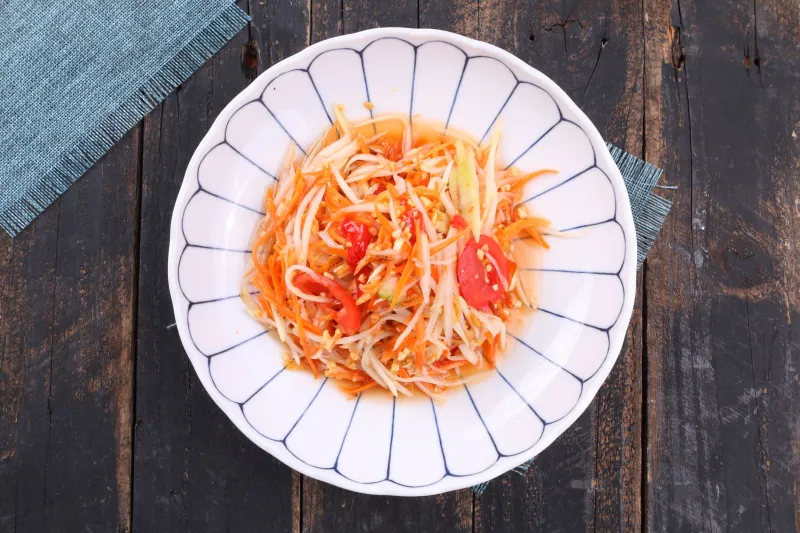
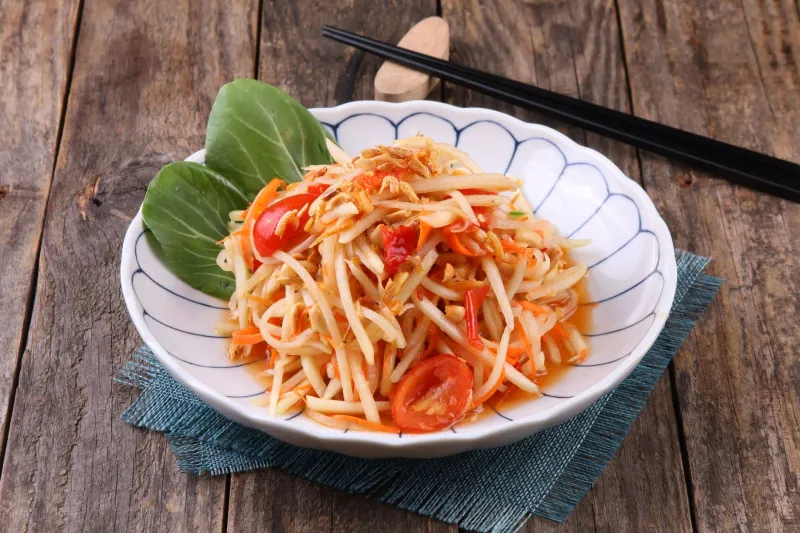
Let's get something out of the way right now: som tam is not a salad in the way Americans typically think about salad. It's not about tossing things together and hoping the dressing coats everything evenly. It's about transformation — the kind that happens when a heavy pestle meets garlic, chilies, and green papaya in rapid, controlled succession. The mortar isn't just a vessel. It's the whole technique.
If you've been slicing your green papaya into thin strips, whisking together a dressing on the side, and calling it som tam, this article is going to be a little uncomfortable. Not because you did anything wrong, exactly — but because you've been making a completely different dish and just calling it by the same name.
What "Bruising" Actually Means (And Why It's Not Decorative)
When you pound ingredients in a mortar, you're not just breaking them into smaller pieces. You're rupturing cell walls in a way that releases compounds that would otherwise stay locked inside the plant tissue. Garlic is the easiest example: when you smash a clove instead of slicing it, you trigger the enzymatic reaction that produces allicin — the sharp, pungent compound responsible for that aggressive garlic flavor. Sliced garlic releases far less of it. The knife separates; the pestle destroys, and that destruction is exactly the point.
The same principle applies to Thai chilies. Chopping them releases heat, sure, but pounding them opens up the capsaicin-containing cells more completely while simultaneously releasing the aromatic oils from the skin. You get heat and fragrance together, fused into the paste that becomes the backbone of the whole salad. Chopped chilies just sit on top of things. Pounded chilies become the dish.
Green beans and cherry tomatoes get the same treatment, though with a lighter touch. You're not pulverizing them — you're cracking them open just enough that they absorb the surrounding flavors rather than resisting them. A whole cherry tomato in som tam is almost useless. A gently crushed one bleeds its juice directly into the lime-fish sauce mixture and thickens everything into something that actually clings to the papaya.
The Papaya Problem
Green papaya has almost no flavor on its own. That's not a criticism — it's the point. It's a vehicle, a textural canvas that exists to carry everything else. But here's where technique matters enormously: the surface of each shredded papaya strand needs to be slightly roughed up, not pristine.
When you use a traditional papaya shredder (the kind that creates those thin, slightly jagged strips) and then add those strips to the mortar for a few light presses, you're creating micro-abrasions on the surface of the papaya. Those tiny cuts and rough patches are what allow the dressing to penetrate rather than just coat. Papaya shredded with a standard box grater or julienne peeler comes out too smooth, too uniform — and the dressing slides right off.
This is one of those places where the traditional tool exists for a very specific reason, not nostalgia.
Choosing Your Mortar: Weight Is a Feature, Not a Burden
If you're in the US and shopping for a mortar and pestle, you're going to encounter a lot of options — marble sets, ceramic bowls with wooden pestles, decorative granite pieces that look great on a countertop and do approximately nothing useful. For som tam, you want a clay or terracotta mortar, ideally with a wooden pestle.
Here's why the material combination matters: clay has just enough give that it absorbs some of the impact without shattering ingredients completely. The wooden pestle is lighter than granite or marble, which gives you more control over pressure. You're not trying to make a paste with everything — you want a spectrum of textures in the finished dish. The garlic and chilies should be fully broken down. The papaya should be bruised but still have bite. The tomatoes should be somewhere in between. A heavy granite setup makes that kind of precision harder because you're working against the weight of the tool rather than guiding it.
If you already own a large granite mortar and pestle (the Thai version, not the tiny spice-grinding kind), you can absolutely make som tam in it — just ease up on the pressure and work in shorter pulses.
The Rhythm of the Pound
This sounds almost absurd to say, but how you pound matters as much as what you're pounding. Watch any street vendor in Thailand and you'll notice it's not random — there's a fold-and-pound rhythm happening. You press and rotate the ingredients with a spoon or spatula between strikes, folding everything back into the center so the pestle hits different surfaces each time.
The goal is even exposure. If you just pound straight down repeatedly in the same spot, you'll obliterate whatever's at the bottom while leaving the top layers untouched. The fold-and-pound method ensures every piece of papaya gets its moment under the pestle, every chunk of tomato gets cracked, every bean gets a bruise.
Start with the hard aromatics — garlic first, then chilies. Get those fully broken down before anything else goes in. Then add palm sugar and work it into the paste. The liquid ingredients (lime juice, fish sauce) come in after the papaya, because you want the papaya to take on some dry bruising before it gets wet. Once the liquids go in, the whole mixture loosens up fast, and you switch from pounding to a gentler fold-and-toss motion.
What a Knife Salad Actually Tastes Like
To be fair to the knife method — and there are recipes out there that use it — it produces something that is genuinely good. Bright, fresh, crunchy, well-dressed. But it tastes like a lime-dressed green papaya slaw with peanuts. The flavors are distinct and separate. You taste the papaya, then you taste the dressing, then you taste the heat.
A properly pounded som tam doesn't work that way. The flavors are integrated. The heat from the chilies isn't a separate experience — it's threaded through the whole dish. The fish sauce and lime don't taste like dressing; they taste like the papaya itself got more interesting. That's the transformation that only happens when you rupture cells rather than slice them.
It's the difference between a dish with components and a dish that's actually unified.
One Last Thing About Practice
Your first mortar-pounded som tam is probably going to be uneven — some parts too mushy, some still too raw. That's completely fine. The technique takes a few rounds to internalize, and every mortar behaves slightly differently. Pay attention to what the papaya looks like after each round of pounding: you want it to look slightly translucent at the edges, not white and opaque (under-bruised) or completely soft (over-worked).
Once you hit that window, you'll know it. And you'll also understand, in a way that no amount of reading can fully convey, why every som tam vendor in Thailand starts with a mortar before they touch anything else.