Sweetener Showdown: Tamarind, Palm Sugar, and Brown Sugar Walk Into a Thai Kitchen
Sweetness in Thai cooking is not decoration. It's architecture. It's the element that softens sourness, rounds out salt, and gives a sauce or curry its spine. Get the sweetener wrong and the dish doesn't taste bad exactly — it just tastes slightly off, like a song played in the wrong key. You can feel something is missing even if you can't name it.
The problem is that most American home cooks default to whatever's already in the pantry. White sugar works in a pinch. Brown sugar is close enough sometimes. But once you start cooking Thai food seriously, you realize pretty quickly that "close enough" is doing a lot of heavy lifting. Let's break down what's actually going on with the main sweetening agents in Thai cuisine and why each one matters.
Palm Sugar: The Baseline You Should Know
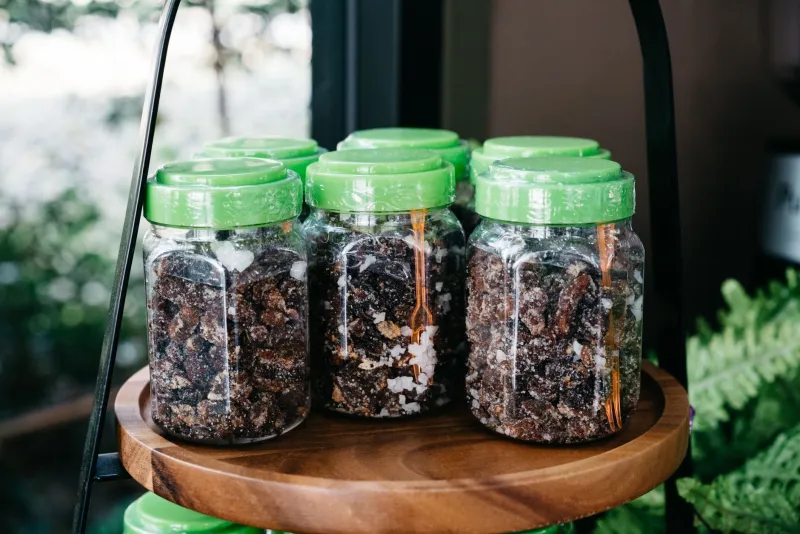
If there's a default sweetener in Thai cooking, it's palm sugar — specifically the kind made from coconut palms or sugar palms, sold in rounds, cylinders, or soft paste form. Its flavor is caramel-adjacent but earthier, with a slight floral quality that white sugar simply doesn't have. It dissolves slowly and doesn't spike sweetness the way refined sugar does. It adds body.
In Thai cooking, palm sugar shows up in everything from pad thai to massaman curry to naam jim dipping sauces. It's particularly important in dishes where you need sweetness to coexist with funky, fermented, or sour flavors without dominating them. The subtle complexity of palm sugar means it integrates rather than announces itself.
In the US, you can find palm sugar at most Asian grocery stores — look for the Thai brand that comes in a plastic tub of soft paste, or the harder cylinders wrapped in plastic. The soft paste is easier to work with. If you're buying the hard rounds, you'll need to shave or grate them before using, which takes a minute but is worth it.
Best used in: Pad thai, massaman curry, tamarind-based sauces, most central Thai dishes.
Tamarind: When Sweetness Comes With a Story
Tamarind is technically more sour than sweet, but in Thai cooking it functions as both. Tamarind paste — made by dissolving the pulp from tamarind pods in warm water and straining out the seeds and fibers — brings a dark, complex tartness that's also slightly sweet. It's the backbone of pad thai's sauce. It's what gives certain dipping sauces their depth. It's the souring agent in some curries and the finishing note in others.
The sweetness in tamarind is real but it's inseparable from the acidity. You can't use tamarind as a straight sugar substitute, but understanding it as part of the sweet-sour spectrum is essential. When a dish calls for tamarind and palm sugar together — which is common — you're building a layered sweetness that includes brightness, depth, and a slight bitterness all at once.
In the US, tamarind comes in a few forms. Tamarind concentrate (the dark, thick paste in jars) is convenient but can be quite intense. Tamarind pulp blocks — the compressed bricks of dried pulp — are more traditional and give you more control. Soak a chunk in hot water, work it with your fingers, and strain it. It takes five minutes and the flavor difference is noticeable.
Best used in: Pad thai sauce, tamarind-based dipping sauces, Panang curry, some northern Thai dishes.
Jaggery: The Underrated Wild Card
Jaggery is an unrefined cane sugar common across South and Southeast Asia, and while it's more associated with Indian cooking in the American imagination, it absolutely shows up in Thai kitchens — particularly in southern Thai cooking, where Indian and Malay influences run deep. Jaggery has a more pronounced molasses note than palm sugar, darker and slightly smokier. It's robust where palm sugar is subtle.
In dishes that can handle a bolder sweetness — rich southern curries, certain braised dishes, some desserts — jaggery can be a genuinely interesting choice. It won't disappear into the background. That's either a feature or a bug depending on what you're making.
Jaggery is increasingly easy to find in the US. Indian grocery stores carry it reliably, and it's available online. It usually comes in hard blocks or as a soft paste. Like palm sugar, the paste form is easiest to work with.
Best used in: Southern Thai curries, dishes with strong spice profiles, desserts where a caramel depth is welcome.
Brown Sugar and White Sugar: The Honest Substitution Guide
Let's be real — sometimes you're mid-recipe and you're out of palm sugar. Brown sugar is the better substitution of the two because the molasses content gives it some of the depth that palm sugar provides. It's not the same, but it's not a disaster either. Use slightly less than the recipe calls for, since brown sugar can be more aggressively sweet.
White sugar is a last resort. It's clean and neutral, which sounds fine until you realize that Thai cooking specifically depends on sweeteners that bring something beyond pure sweetness. White sugar can make a dish taste flat or one-dimensional in a way that's hard to pinpoint. Use it if you have to, but know you're giving something up.
For tamarind specifically, there's no real substitute that captures both the sourness and the sweetness simultaneously. Some recipes suggest lime juice plus a little sugar as a workaround — it gets the acidity right but misses the depth entirely. If tamarind is central to a dish, it's worth tracking down the real thing.
Making Intentional Choices
The bigger shift here isn't about memorizing which sweetener goes where. It's about understanding that sweetness in Thai cooking is a variable with texture, not just a dial you turn up or down. Palm sugar integrates. Jaggery asserts. Tamarind complicates. Brown sugar approximates. White sugar simplifies.
Once you start thinking about sweeteners that way — as ingredients with personality rather than interchangeable units of sweetness — your Thai cooking gets more intentional across the board. You stop asking "how much sugar?" and start asking "what kind of sweet does this dish need?" That's a different question, and it leads to better food.